
My DMs are full of the same question every week.
"How do I break into tech sales?" "How do I land my first BDR role?" "What advice would you give to someone trying to land a role in SaaS?"
I coach sales students at UNM. I've helped place people into their first B2B roles. And I always want to help.
So here's the real process. Not "network more." What I actually look for, what actually works, and what actually gets you through the interview.
If HubSpot specifically is on your list, I also wrote up exactly what the hiring process looks like there, based on conversations with reps who've gone through it.
In this post:
Find the Right Company First
Most people apply to whatever's open. That's backwards. The company matters more than the title, because the wrong one burns you out in six months.
To find companies that I might want to target, I use RepVue. It's built for sales specifically, rated by reps who actually carried a number there.
What I look for:
High Quota Attainment (60%+ is amazing, less than 45% is red flags)
Rating count (over 100 is excellent, under 20 raises question marks)
Employee comments trending positive, not negative over the last 6-12 months
OTE range (figure out what you're looking to make)
I use this exact filter to narrow my own search. It's not complicated. It just takes actually looking.
Try to identify 5-10 companies that you might be interested in working for. Then check for roles you might be interested in applying for. You don't want to spray and pray when trying to break into tech. You have to treat this like a job.
Bonus: If you're remote in a more rural area (like me), copy all the top attainment companies on RepVue and ask Claude/ChatGPT to find the companies on the list that might hire out of your state to save you some time.
Get Noticed Before You Apply
Once you've got 5-10 target companies, don't just find the hiring manager. Add everyone you can find in the sales org on LinkedIn. I usually send a blank connection request, no note, just get connected.
The best way to do this is find the company page on LinkedIn, click People, then narrow into the job segment you're looking for, scroll down and send connection requests.
Then I run the same process every time:
Connect on LinkedIn first. Blank connection request is fine.
Send a personalized DM. Reference something real, their background, a post, a result on their team. State your case in a line or two. Ask for 15 minutes, not a job.
Example:
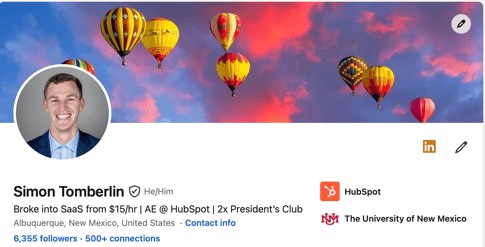
"Hey Simon, saw that you moved from Comcast to HubSpot after winning President's Club twice. I'm sure that was a tough call to leave a place where you did so well, what caused you to take the leap?
I'm currently a BDR at COMPANY looking to apply for an AE role at HubSpot. Would love to hear from you what surprised you the most since starting at HubSpot and any advice you'd give to someone in their first 90 days starting a role at HubSpot?
Do you have 15 minutes either on Tuesday between 9-11AM EST, or Wednesday between 10-12PM EST? If not, let me know if another time would work better for you.
I've attached my resume for your review as well.
P.S. Saw you're based out of Albuquerque, would love to go to the Balloon Fiesta one day"
If they don't reply, follow up two days later with a personalized voice memo. Nobody does this. It's the difference between another message in their inbox and an actual human voice.
(Note, you can only send voice memos from a mobile device, not a computer)
Example:
"Hey Simon, I'm sure you're super busy so thought this might be easier for you to respond to. I'm a BDR at COMPANY currently, and trying hard to break into HubSpot. I've read a few of your posts on the sales process and thought you might be a great person to reach out to. Are you available to chat for 15 minutes on Tuesday or Wednesday? I'd love to hear about the first 90 days on the job and what recommendations you might give to a new hire to hit the ground running."
Ask for a referral. The best way to get past an AI screener is to have a direct referral from someone in the business.
After chatting back and forth with someone and demonstrating your value, shoot your shot and ask what you'd need to do for them to feel comfortable submitting an employee referral for you.
Don't be too pushy here, they don't owe you anything, but keep in mind a lot of companies pay employees for successful referrals.
Bonus: Cold call the hiring manager directly.
Use a tool like Full Enrich (they have a free trial you can use) to find their phone number and reach out directly.
Here's how I'd prep for that cold call:
Do a quick search for the company you're applying to looking for a new product they're selling or a new initiative they're running. Do 5 minutes of research to understand the product/goal and how you think it might help. Then push down the fear and press call.
Try not to overthink here. Sales leaders LOVE it when applicants call them. Just swallow the frog and hit dial.
Examples:
"Hey is this Simon? Great, I saw that you are hiring for new AE's. I'm on the job market and after doing some research I saw that the team also just acquired 'ABC sales.' I imagine that with a new acquisition your sales process might change slightly. If you had to pick one, what is the most important trait you're looking for in your next new hire?"
"Hey is this Simon? Great, I saw that you're hiring for new AE's, and that the HubSpot team recently just launched 'Agent Hub.' I imagine a big focus for leadership is making sure the team is prioritizing selling this new product. As you think about your next hire, what would you be looking for them to bring to the team during this time of growth?"
Standing Out on Paper
When you're ready to hit apply, go line by line through the job description and make sure your resume speaks to every single bullet point.
Don't make a recruiter guess whether you're qualified.
And lead with real numbers, with context.
Don't just say you finished first in your segment, say first out of how many reps. First out of 4 and first out of 400 are very different claims, and the number without context doesn't mean anything to whoever's reading it.
Ever since AI tools came out, I talk to a lot of people whose resumes all look the same. Claude has a default style for its resumes it produces.
Notice the difference between a more generic Claude resume vs one with more customization?
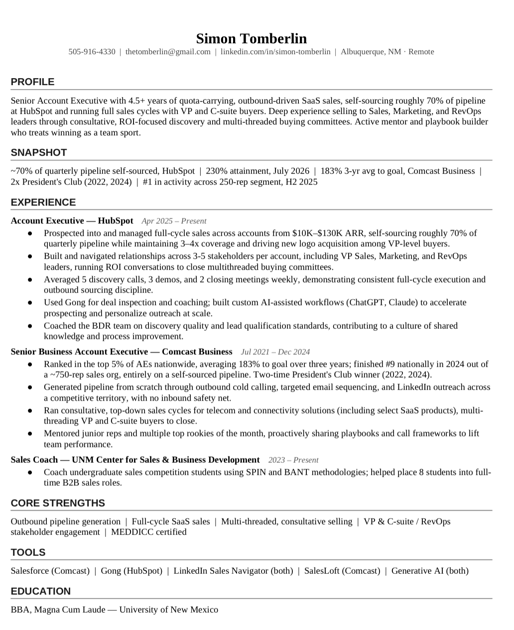
vs
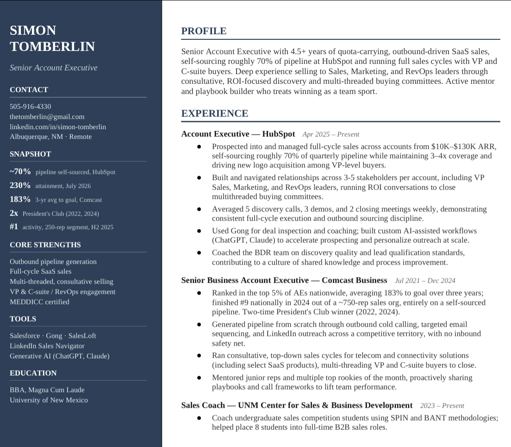
And this is just me saying this, someone who doesn't comb through hundreds of resumes looking for the right fit for their company.
This is what an industry leader hiring for a sales role had to say:
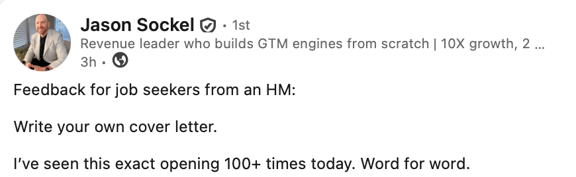
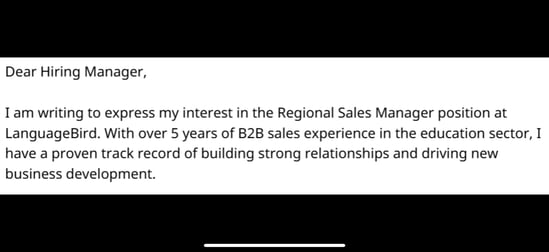
I'm a huge advocate of utilizing AI. And in the past I would have recommended utilizing Claude to write your resume. But now everyone is doing it. And when everyone else is zigging, it's the best time to zag.
Getting through the resume screen is only half of it
Join the newsletter for the deal breakdowns, cold call teardowns, and interview prep I don't post anywhere else.
Do the Research Nobody Else Does
Once you've got a conversation or interview lined up, this is where you can really separate yourself.
Check the tech stack. You can find this on RepVue or by asking reps. If you don't have experience with one, do a quick search and learn what it does. See if you've used anything similar.
Know their methodology. If the job post names MEDDICC, SPIN, Challenger, be ready to actually talk through it.
Pass the 2-3 sentence test. Who they sell to, what they sell, how they're different. Say it without notes.
Get certified. If the company offers free certifications, do them. It shows you did the work before anyone asked you to.
Use the tool. If they have a free trial, download it and play around. You're about to try to sell this product. You should actually know what it does.
Research the person, not just the company. Find something real in their LinkedIn bio before any call. One genuine mention builds more rapport than any opening line.
Bonus: listen to leadership on a podcast. Culture flows top down, and almost nobody does this. Google "[Company] CEO podcast," play it at 2x, write down 2-3 things you took away.
If you were a recruiter and someone said they'd been listening to your CEO's podcast, wouldn't you be impressed?
Win the Interview
Getting the interview is half the job. The other half is a story that holds together across every round.
Lead With a Point of View
What separates you is a point of view. Take everything you researched and turn it into an actual opinion on where the company is headed. Right off the rip.
Example:
"NAME, great to connect. Super excited for this conversation today, I've been listening to a few podcasts, and it sounds like Yamini and the entire sales org are focused on growing the agentic side of HubSpot. After testing out the Agent Hub myself, and completing the AI for Marketers Course, I'm super fired up to share with you how I'd go about leading with AI while selling to Sales and Marketing contacts."
Tell a Consistent Story
Pick five words that describe you. Mine are coachable, adaptable, hard-working, positive, out-of-the-box thinker. Every answer you give should reinforce one of them.
If one of your words is coachable, but when asked what your biggest weakness is you say that you're stubborn, that can set off a red flag. Even if both things can be true at once.
Build a bank of 5-8 stories. Deals won, deals lost, real struggles. Know them cold so you're never inventing an answer live. Use the STAR method.
Examples:
"I recently closed a 110K ARR deal with a company called X. During the discovery process, it became apparent to me that we would have 3 department heads weighing in on the decision, before it came to the C-Suite, even though the CEO was the final decision maker. I made sure to schedule time with each department head 1:1 to find out what would move the needle most for them, while building out an ROI calculator for each department and crafted a one-pager to present to the C-Suite. Once we got to that point, I had built 3 internal champions with 3 different budgets to ensure we had plenty of budget allocation to go around, and was able to close the deal with minimal discounting."
"In the past if I had a bad month I would really beat myself up mentally and it would make it hard to bounce back the next month. Recognizing this, I took time to reach out to other tenured reps to learn about their processes, and found that reps who could bounce back well typically avoided negative self talk. So over the next 3 months, every Friday I would spend 10 minutes reflecting on my positive traits, and over time, I found myself far more resilient and able to not define myself based on my performance, which in turn greatly improved my performance."
Hiring managers want succinct, consistent stories. Your job is making sure no red flags pop up and your story matches at every stage, recruiter to final round.
Think of it as a one-pager on yourself. Who you are, what you're about, how that solves their actual problem.
No one wants to hire a lazy rep who gives up when the going gets tough, and needs a manager to give them direction on everything that they do. You are selling yourself, lead with value, and how you will help fix challenges that a hiring manager might have.
Follow Up
WAY TOO MANY people don't follow up.
It is so simple. Yet so many people miss it.
Email every single person you met with individually. Send it within a day of any interview or call.
Reference something specific you actually talked about, not a generic "great speaking with you."
If they mentioned a challenge or gave you feedback during the conversation, show them you were listening. Talk through how you'd actually apply it going forward, not just that you heard it.
Close by making yourself available. Offer more time for questions, another conversation, whatever they need to feel good about the decision.
You want them walking away thinking you're easy to keep the conversation going with, not someone they have to chase down.
It takes ten minutes and almost nobody does it.
Bonus: If you're not sure what someone's email is, just guess. Look at the format of someone else in the company's email. If Simon's email is simon@simonsayssales.xyz, then Brian's email is probably brian@simonsayssales.xyz.
If You Fail, Try Try Again
You might go through this entire list, and do absolutely everything right, and still not get the job.
It stings. I've been there.
Deep breaths. Let yourself feel discouraged, upset, angry. You put so much effort in, and still weren't able to get there. It sucks.
And then pick yourself up again and try again. Every single point of failure is an opportunity to learn and grow.
You can't control what people think about you, and there is constantly so much happening behind the scenes that you'll never know about.
But if you never try, you can never win.
Land the Job
After countless applications and job interviews, the highs and lows of a job search, you finally land the coveted offer.
Congrats, you broke into tech sales!
Go update your LinkedIn, polish your fancy new title, and go update your budget with your fancy new OTE.
Now the real hard work begins. My own first 90 days were rougher than I expected, remote, no mentor for a month, on a brand-new team. I wrote about exactly what that looked like in What Nobody Tells You About Your First 90 Days in SaaS Sales, so you know what's actually normal versus what's a red flag.
And if you want live practice before any of this, my 1:1 interview prep coaching is built around exactly what's in this post: mock cold calls, discovery calls, and the story work above, with real feedback instead of just a framework.
Want more like this?
Join the newsletter for deal breakdowns, cold call teardowns, and everyday sales stuff I don't post anywhere else.